


October 2025 |
From the Alps to the Adriatic in 8 Days – and why the 2026 guided tour is even better
Curves, mountains, lakes – and that feeling that behind every bend not only a new panorama awaits, but a new story. Our 2025 motorcycle journey took us over eight days from the Swiss Alps to the Slovenian Adriatic: along ancient Roman routes, through valleys with their own language and identity, into landscapes shaped by the First World War – and back out to the sea, where Venetian façades glow in the warm evening light.
This tour was not “just riding.” It was about discovery, awe, and enjoyment – and that is exactly why we are turning it into a guided Slovenia round tour for 2026: with the right balance of flow on the road, meaningful stops, good food, and historical moments that are easily passed by if you simply ride through.
Day 1 – Alpine warm-up in the Vinschgau & the Reschensee “church tower in the water”
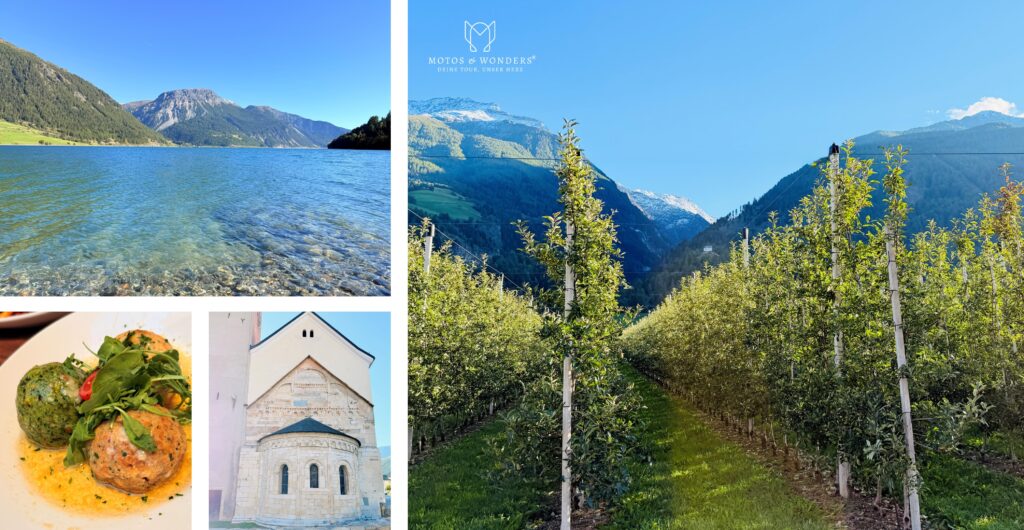
The engine purrs, the morning is clear, and a veil of mist still hangs over the Alps – the perfect start to our Alpine–Adriatic motorcycle journey towards South Tyrol. No sooner do you fall into the rhythm of curves and fresh air than it appears: an image that feels like a film still – the church tower rising from Lake Resia, silent, iconic, slightly surreal.
What looks like a postcard scene carries a serious story. The reservoir was created in 1950 for hydropower, flooding entire villages – and the tower remains as a visible witness. As if that weren’t story enough, you ride here along one of Europe’s ancient lifelines: the Via Claudia Augusta, a Roman route across the Alps that once connected trade, people, and ideas between north and south.
By evening, we arrive in the Vinschgau Valley – apple orchards, the Adige River, villages that feel like painted scenes. In Laas, you encounter Romanesque churches and that quiet South Tyrolean sense of ease: eat well, sleep well, and continue tomorrow. Dumplings, butter, a glass of something to go with it – and you realise: your mind has fully shifted into travel mode.
Day 2 – Layers of Time: From Ladin Valleys to Roman Stones
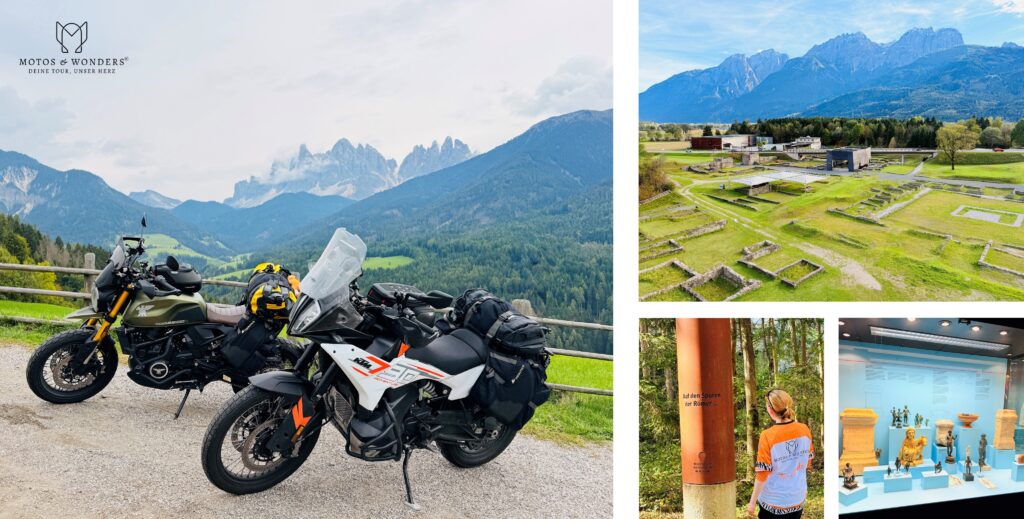
Dolomite light is something else – bright limestone peaks glowing almost white, forests switching to open alpine meadows and back again. We ride into the Villnöss Valley, and it becomes clear that the fascination here isn’t only geological. It’s cultural, too.
This part of the Dolomites is home to the Ladin people, a Rhaeto-Romance minority with their own language and strong regional identity. That’s why we stop in San Martino in Badia to visit the Museum Ladin (Ciastel de Tor). Inside the old castle walls, you don’t get a dusty display – you get a living sense of how a mountain community holds on to language, craft, tradition and everyday stories.
And then there’s a personal footnote that makes the scenery feel even more “right”: this is also the wider region where Reinhold Messner grew up – and where his relationship with rock and height took root early on. Standing beneath these walls of stone, it’s easy to understand why.
Before turning our way toward Kärnten, Austria, we take a moment to explore Aguntum, the ruins of a Roman town near the modern-day village of Dölsach. Wandering among the remnants of streets, temples, and homes, you can almost imagine the rhythms of daily life two thousand years ago. The stones may be silent, but they carry stories of trade, community, and ambition—reminders that human history here runs deep, long before the mountains around us became a playground for climbers and adventurers. It’s a quiet pause that adds another layer to the landscape, connecting past and present as we continue our journey.
Day 3 – Into Slovenia via the Wurzen Pass, Triglav National Park & Bled
At some point the trip shifts gears – not in speed, but in atmosphere. We cross into Slovenia over the Wurzen Pass (Korensko sedlo), a steep, twisty gateway through the Karawanks. It’s the perfect “portal moment”: you don’t just arrive in a new country, you roll into it.
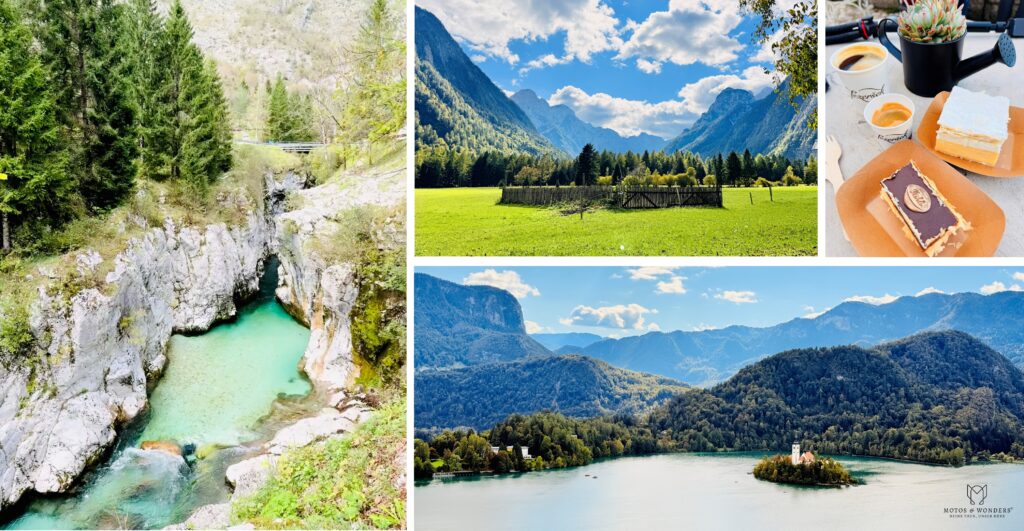
From there, we dive into the world of Triglav National Park – bright water, cold air, dense green, and roads that feel like they were laid down with motorcycles in mind. With the Vršič Pass unavailable during our trip, we reroute on the fly – and get rewarded. Slovenia has that rare talent for turning Plan B into a highlight.
In the evening we reach Bled. Yes, it’s famous. Yes, it’s popular. But it still lands. The climb up to Bled Castle is a classic for a reason: the views over the lake and island are genuinely stunning, the kind that resets your brain in a single look. Inside, the castle museum adds real depth – including archaeological and prehistoric elements that remind you this place has been meaningful long before it became a postcard.
And here’s a “did you know?” that fits perfectly with that theme of deep time: Slovenia is home to the Divje Babe find, often described as one of the world’s oldest “flutes”. Researchers still debate whether it’s truly a human-made instrument or the result of natural/animal activity – and that uncertainty is part of what makes it so fascinating. The past isn’t always neat; it’s a puzzle with missing pieces.
Day 4 – Kropa’s craft heritage, roadside memorials & then the Adriatic: Piran and salt
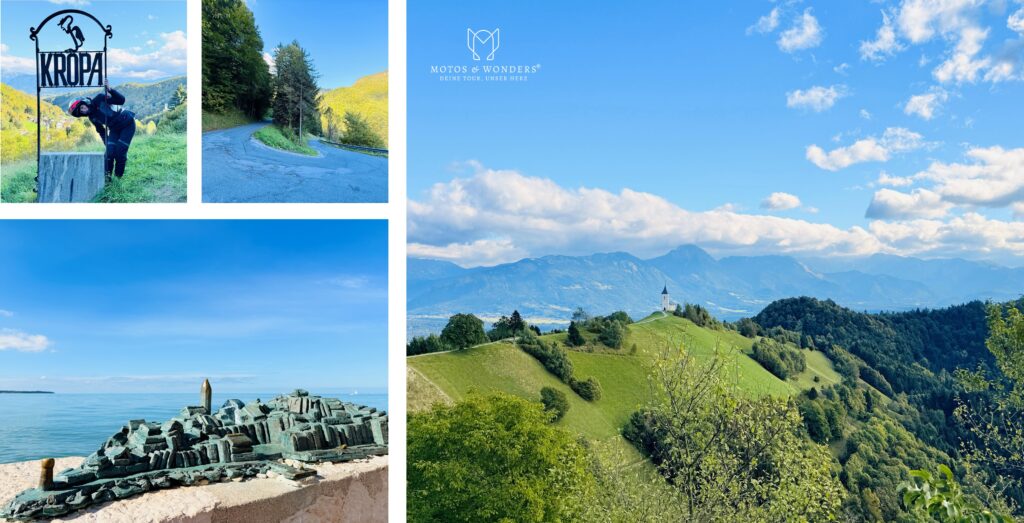
The mountains begin to soften, hills take over, and the light grows gentler. We ride through Kropa – a village with a deep-rooted craft heritage shaped by ironworking, blacksmiths, nails, and centuries of labour that once set the rhythm of daily life. But Kropa is more than “picturesque craftsmanship.” Along this stretch of road, you repeatedly encounter remembrance: memorials, plaques, and monuments. In many regions, especially the First and Second World Wars have left visible marks. You ride through beautiful landscapes, but you also ride through a country that has learned not to hide its history.
And then the sea arrives. Piran feels like a scene change: Venetian-style architecture, tight alleys, seagulls overhead, and that unmistakable Adriatic vibe. The town’s main square – Tartini Square – sits where an inner harbour once was, and you can still feel how closely this place has always been tied to the water. There’s another layer many first-time visitors miss: salt.
Just outside Piran are the Sečovlje salt pans, where salt has been harvested for centuries and is still produced in traditional ways. Suddenly the town makes even more sense – not only as a pretty coastal gem, but as a place shaped by trade, craft and a very specific economy.
Day 5 – Forest roads, the Vipava side, and Goriška Brda: Slovenia’s wine hills with a big reputation
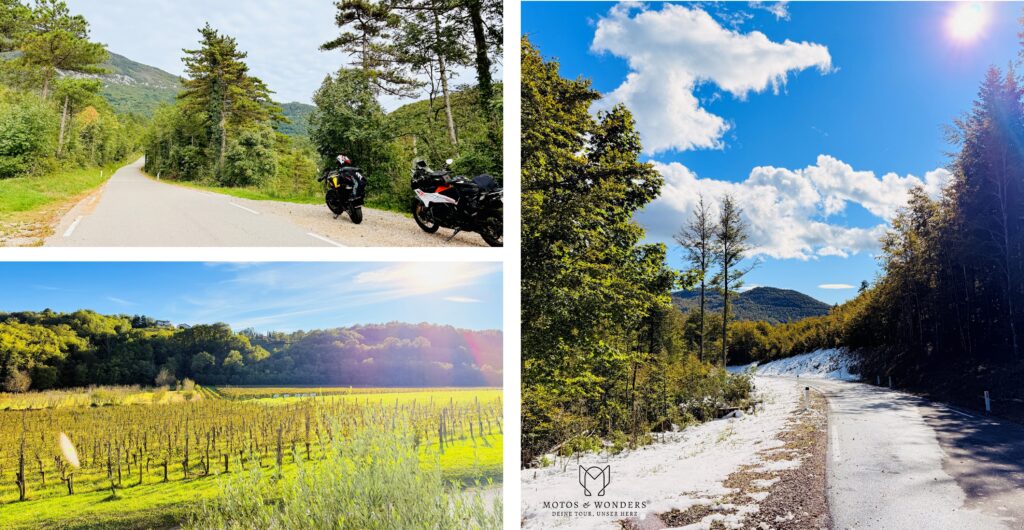
We head back inland into quieter terrain: forest roads, elevation, cold pockets of air even when the sun feels strong. And then the landscape opens into the gentle hills of Goriška Brda (Brda) – often compared to “Slovenia’s Tuscany”, but with its own edge and identity.
And yes: Brda is not just beautiful – it is seriously strong when it comes to wine. The region is considered one of Slovenia’s most renowned wine landscapes and is also internationally visible, not only for its excellent wines but as a destination where wine, cuisine, and landscape come together naturally.
That is exactly why an evening with a local winemaker fits so perfectly here. You are not simply “having a glass of wine” – you are sitting in a region that has earned its reputation over time, yet has remained grounded and authentic.
Day 6 – The ridge road along the border, then the Soča Valley: emerald water and the weight of history
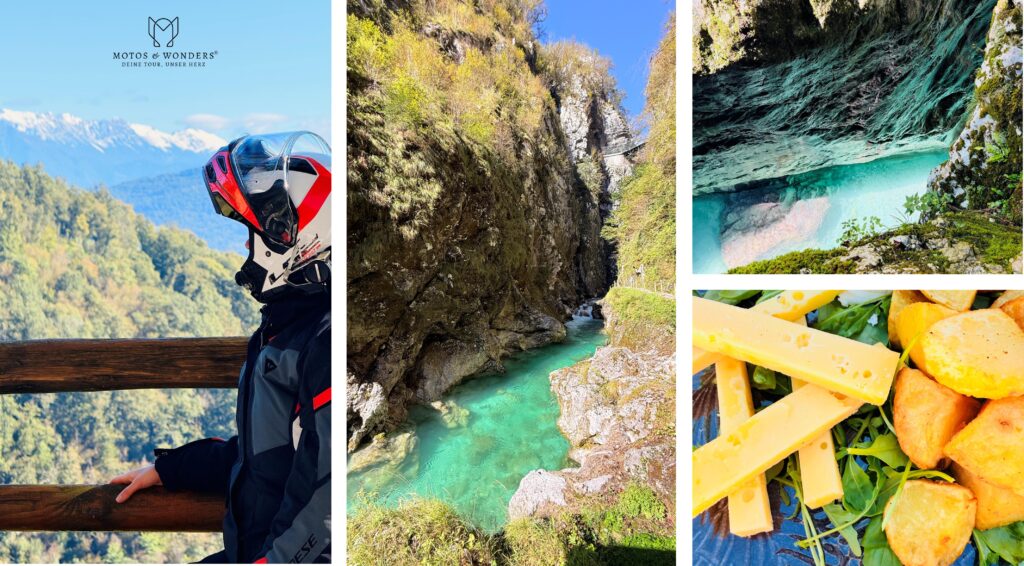
This day is pure contrast in the best way. In the morning we ride Slovenia’s border ridge road – high, open, panoramic, the kind of route that makes you go quiet inside your helmet. Then we drop down into the Soča Valley, where the river shifts between emerald and turquoise depending on the light. It doesn’t look real.
And yet the Soča isn’t only a nature spectacle – it’s also a historical landscape. Parts of this region were tied to the Isonzo/Soča Front during World War I, and knowing that changes the way you see it. Beauty and memory sit close together here.
We stop at the Tolmin Gorge, where boardwalks thread through rock, water runs cold, and the air feels different – like the valley has its own microclimate.
Weather keeps the Mangart panoramic road off the table, but the day doesn’t lose any power. We continue toward Tarvisio via the Predil Pass, still buzzing from the Soča’s colour.
Day 7 – Back through South Tyrol: Lago di Braies (quick stop) & strawberry season in the Martell Valley
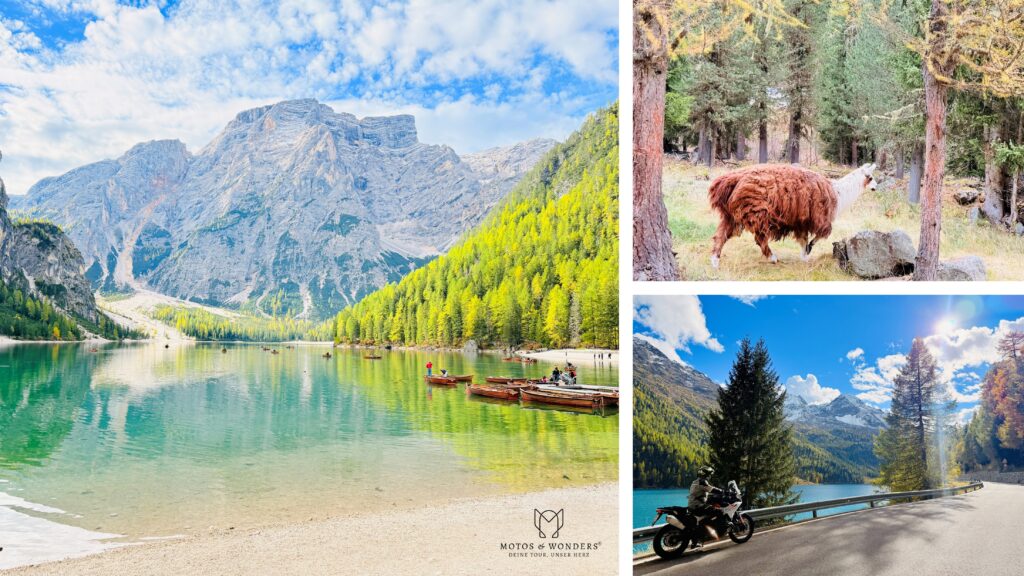
We point the bikes homeward, but we’re not done collecting moments. We stop at Lago di Braies/Pragser Wildsee (Italy) – and yes, it’s stunning. It’s also a tourist magnet, and you can feel that immediately. So we do it our way: take in the beauty, breathe it once, then get moving again. Motorcycling, for us, is flow – not queues with a view.
For our final overnight we head into the Martell Valley, famous for its strawberries. And we get lucky: we’re still able to taste some of the last strawberries of the season. After days of curves and culture, it’s the sweetest possible full stop.
Day 8 – Müstair, Charlemagne’s legend & the perfect ending at Lake Walen
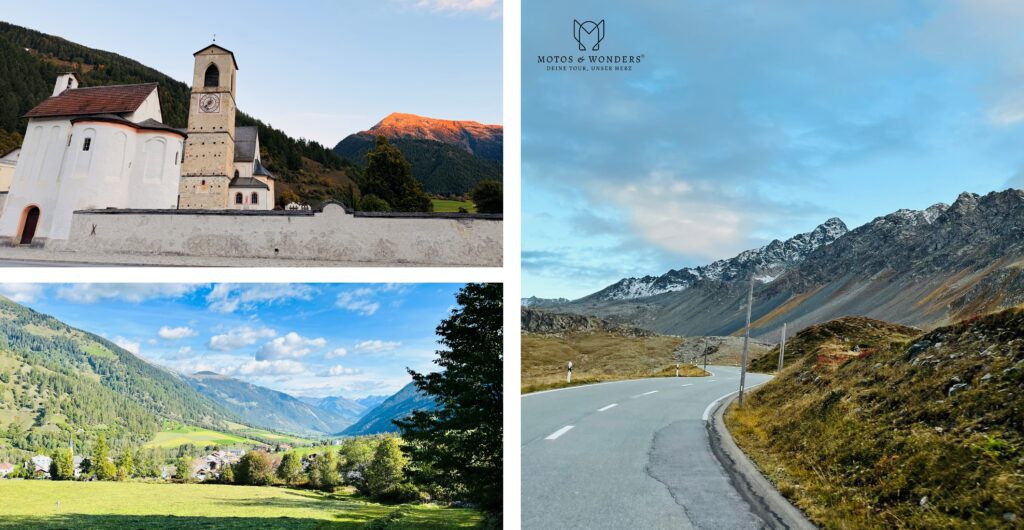
To close the circle, we add one more deep-history highlight back in Switzerland: the Benedictine Convent of St John in Müstair, a UNESCO World Heritage site founded around 775. There’s even a legendary connection to Charlemagne – one of those stories that may not be provable in every detail, but still gives the place a powerful sense of age and meaning.
Then it’s homeward: mountain passes, familiar roads, and that feeling of carrying a whole new map inside your head. We end the day by Lake Walen/Walensee, watching the light drop over water and rock. Helm off. Legs stretched. Quiet smiles. Exactly the way an eight-day journey should finish.
Final thoughts – Why this route works so well as a guided tour in 2026
This Alps-to-Adriatic ride isn’t only a “beautiful route.” It’s a sequence of stories: Roman corridors, living minority culture in the Dolomites, castle museums, memorial landscapes, salt pans, wine hills, and one of Europe’s most unreal rivers – all woven together by roads that were made for motorcycles.
If you’ve read this and felt that pull – the urge to stop thinking about it and actually ride it – that’s exactly why we’re offering it as a guided Slovenia tour in 2026.
Slovenia Tour 2026 — Guided Alps → Adriatic adventure
Note about the 2026 tour route: This blog post is a reflection on our 2025 journey and serves as inspiration for the guided 2026 tour. For safety, weather, road closures, official requirements or organisational reasons, the exact route (including stages, passes and stops) may be adjusted.
Small group. Big experience.
This tour works best when we don’t rush: the right viewpoints at the right time, local food, meaningful stops, and roads you’d likely miss if you were trying to “optimise” everything yourself. That’s why we keep the group intentionally small.
Tour infos & registration
👉 See the route, itinerary, dates & book the Slovenia Tour 2026